
Two years ago, my daily spiritual practice had become little more than a background task. I would sit down for my daily Renuka Mata Namjap (mantra chanting), but my mind was entirely elsewhere. I was physically holding my mala, but mentally, I was drafting emails, reviewing my calendar, and processing the endless stream of notifications that define our lives in 2026.
I hit a breaking point when I realized I had completed 108 recitations without consciously hearing a single word I had spoken. The practice meant to ground me was just adding to my cognitive load.
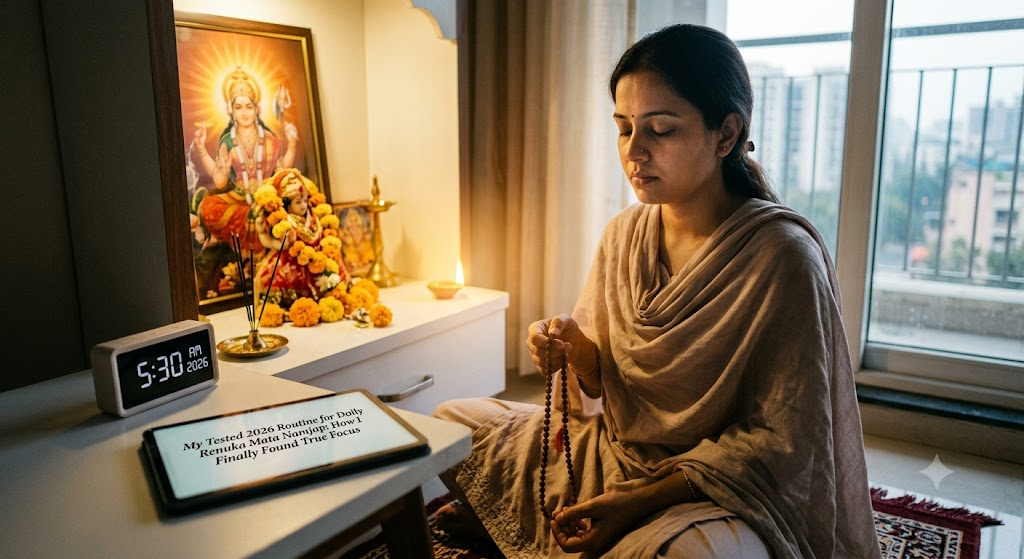
I knew I had to rebuild my routine from the ground up. I stopped trying to squeeze devotion into the margins of my digital life and started carving out a fiercely protected, analog space. After months of refinement, I developed a routine that transformed my daily Renuka Mata Namjap from a rushed obligation into the most deeply focused part of my day.
Here is exactly how I structure my practice, and the lessons I learned along the way.
Why True Focus is Harder (and More Necessary) in 2026
We are living in an era of unprecedented mental fragmentation. With ambient computing and constant connectivity, our attention spans are constantly being traded. When you sit down to chant, you aren’t just battling your own thoughts; you are battling the neural pathways conditioned by years of instant gratification.
I found that treating Namjap as a simple habit wasn’t enough. It requires intentional environmental and mental design to succeed.

The Shift: From Obligation to Anchor
The biggest shift in my mindset was recognizing that Namjap is not a task to check off a productivity list. When invoking the fierce, protective, and nurturing energy of Goddess Renuka, you need a vessel—a calm mind—to receive it. I stopped tracking my “chanting streaks” on an app and returned to the tactile reality of the practice.
My Tested Daily Renuka Mata Namjap Routine
This is the exact sequence I use every morning to ensure my mind is completely aligned with my voice.
Phase 1: The Pre-Dawn Environment
I wake up at 5:15 AM. The world is quiet, and more importantly, the digital world is asleep.
- The Phone Stays Out: My phone charges in the kitchen. I rely on an old-school analog alarm clock.
- Preparation: I take a quick, cool shower. Water is highly effective at resetting the nervous system and shaking off sleep inertia.
- Lighting: I use a single, warm-toned brass Diya (oil lamp). Overhead LED lights trigger wakefulness but scatter focus; a single flame provides a single point of visual anchor.
Phase 2: The Physical Setup
How you sit dictates how you breathe, and how you breathe dictates how you chant.
- Asana: I sit on a dedicated wool and cotton mat (kusha grass base) that I use only for this purpose. Over time, your brain associates this specific texture and space with deep focus.
- Posture: Spine straight, shoulders rolled back.
- The Mala: I use a traditional 108-bead Rudraksha or Kamal Gatta (lotus seed) mala. I keep it stored in a silk pouch when not in use to preserve its sanctity.
Phase 3: The Mental Transition (The 3-Minute Buffer)
I do not start chanting immediately. This was my biggest mistake in the past. Jumping from sleep straight to Namjap causes mental whiplash.
- Breath Awareness: I spend two minutes doing simple Sama Vritti (box breathing)—inhaling for 4 seconds, holding for 4, exhaling for 4.
- Intention Setting (Sankalpa): I mentally state why I am sitting here. “I am dedicating this time to Renuka Mata. All worldly concerns can wait until the sun rises.”
Phase 4: The Chanting Practice
- Audible to Whisper (Vaikhari to Upanshu): I start the first 11 beads by chanting aloud. Hearing my own voice cuts through lingering thoughts. As my focus deepens, I naturally transition to a whisper, and finally to silent, mental repetition (Manasik) for the remainder of the mala.
- Pacing: I do not rush. Each bead corresponds to one complete recitation of the mantra.
Analog vs. Digital Focus Methods
When I stopped relying on technology to manage my spirituality, my focus doubled. Here is a breakdown of what I changed:
| Element | The Flawed Modern Way | My Analog Solution |
| Tracking | Habit-tracking apps | A physical calendar with an “X” |
| Pacing | Audio tracks on headphones | My own breath and voice |
| Counting | Digital clickers / smart rings | Traditional bead Mala |
| Environment | Smart lights and lo-fi beats | A single brass Diya and silence |
3 Pro Tips I Learned the Hard Way
Through trial and error, I discovered a few adjustments that drastically improved the quality of my practice.
Pro Tip 1: The “Cloud” Technique for Intrusive Thoughts
You will get distracted. When you suddenly remember an unpaid bill mid-chant, do not get frustrated. Frustration breaks focus worse than the distraction itself. Visualize the thought as a cloud passing over a mountain. Acknowledge it, let it drift by, and gently bring your thumb back to the current bead.
Pro Tip 2: Anchor the Mantra to Your Heartbeat
If you struggle with mental wandering during silent chanting, try syncing the syllables of the mantra to your natural heartbeat or the rhythm of your breath. This creates a bio-feedback loop that makes it physically difficult for the mind to drift.
Pro Tip 3: End with Stillness, Not Action
The moment you finish the 108th bead, do not immediately stand up. Sit in absolute silence for two minutes. Let the vibration of the mantra settle into your body. This “integration time” is where the profound peace of the practice actually crystallizes.
Conclusion: Building Your Own Practice
Finding true focus in 2026 requires aggressively defending your attention. By stripping away digital crutches and returning to the raw, tactile experience of the mala and your own breath, your daily Renuka Mata Namjap will transform from a chore into an anchor.
If you are ready to reclaim your practice, don’t try to change everything at once. Start small, protect your environment, and let the devotion grow organically.
Your “Start Tomorrow” Checklist
To implement this routine tomorrow morning, follow these specific steps:
- [ ] Tonight: Place your phone in another room and set an analog alarm.
- [ ] Tonight: Lay out your chanting mat, mala, and a Diya (or a single candle) in a quiet corner.
- [ ] Tomorrow Morning: Wake up and do not check any screens. Wash your face or shower immediately.
- [ ] Pre-Practice: Sit on your mat and spend 2 full minutes just focusing on your breath before touching the mala.
- [ ] The Practice: Chant the first 11 mantras out loud to ground your hearing, then transition to a whisper or silent practice.
- [ ] Post-Practice: Sit in complete silence for 2 minutes before standing up to start your day.