
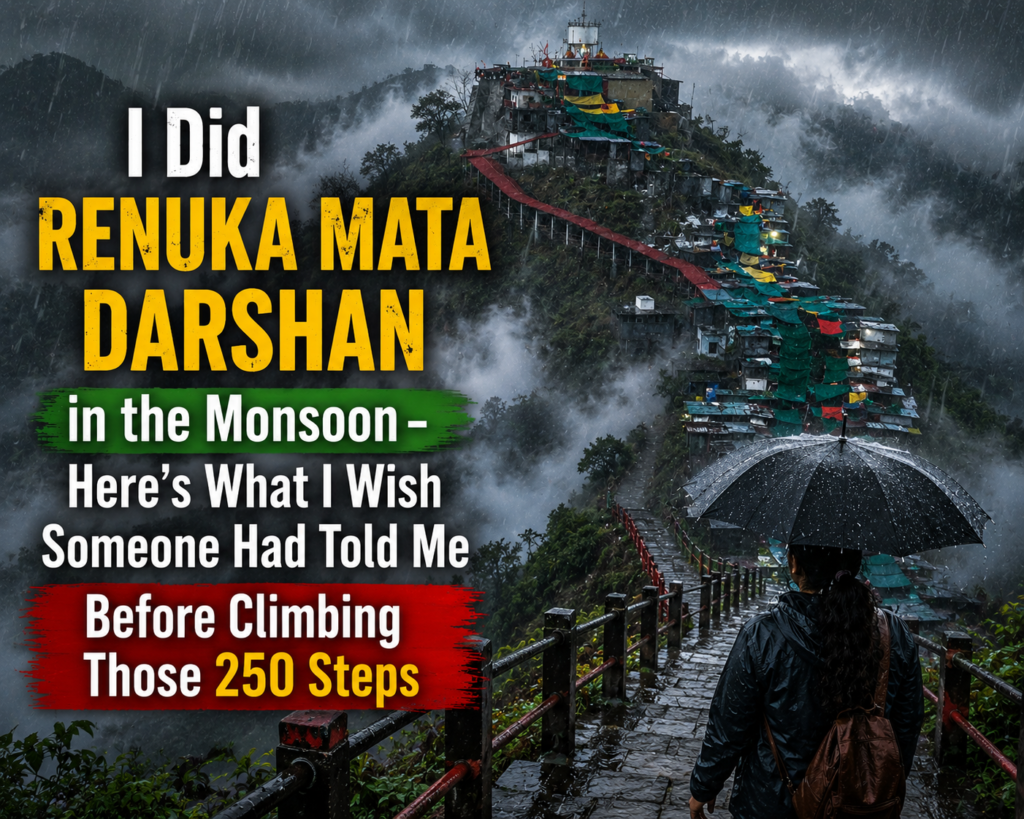
It was pouring, my slippers had zero grip on the wet stone, and I was carrying a bag of coconuts that had gotten so soggy the bottom was starting to tear. Somewhere behind me, an elderly woman was climbing barefoot without a single complaint, and that’s the moment I realized I had prepared for a temple visit, not a monsoon temple visit. Those are two very different things.
If you’re planning a Renuka Mata Darshan at Mahur (Nanded, Maharashtra) during monsoon 2026, I want to save you the mistakes I made. This isn’t a copy-paste temple guide — it’s what actually happened when I went, and what I’d do differently.
Why Monsoon Darshan Is a Completely Different Experience
Most guides tell you October to March is the “best” time to visit Renuka Mata Mandir, and weather-wise, that’s true. But if you’ve ever wanted to see Mahur at its most dramatic — mist rolling over the Sahyadri range, the hills around Mahurgad turning a deep green, waterfalls nearby coming alive — monsoon has its own pull. Fewer tourists, cooler air, and a spiritual quietness that the peak Navratri crowds just don’t allow.
The trade-off: wet stone steps, unpredictable transport, and a temple experience that demands more planning, not less.
The Trinity You’re Actually Visiting
Most people don’t realize Mahur isn’t a single-temple trip. It’s three hilltop shrines:
- Renuka Devi Temple — the main Shaktipeeth, considered the spot where Goddess Renuka’s head remains, per the Parashurama legend
- Dattatreya Temple — reachable by vehicle, no steep climb
- Anasuya Mata Temple — another hilltop climb, less crowded
I only budgeted time for Renuka Devi on day one. Big mistake. In monsoon, with slower travel times and shorter daylight comfort windows, trying to squeeze all three into one day is asking to be rushed and soaked.
My Step-by-Step Reality Check
Getting There
I traveled from Pune via an overnight bus to Nanded, then a local taxi to Mahur — roughly 120 km. In monsoon, factor in extra time; the Nanded-Kinwat road has stretches that slow down considerably in heavy rain. If you’re flying, Nanded Airport is your nearest option, still about 120 km out.
Pro Tip: Book a taxi with a driver familiar with the monsoon route. My driver rerouted us around a waterlogged patch near Kinwat that I later learned had stalled two other cars that same morning.
The Climb: 200-250 Steps
This is the part nobody prepares you for. The steps are stone, and in monsoon they’re slick with a thin layer of moss that doesn’t announce itself until your foot is already sliding.
Things I noticed on the way up:
- Vendors selling puja items line the stairway — handy, but their stalls also narrow the walking path when it’s crowded
- A 24-hour health check-up hub sits near the top, which felt reassuring given the climb
- A free footwear stand at the base — leave your shoes here, but bring a plastic bag for wet socks
- Dolis (palanquins) are available for those who can’t manage the climb, which matters more in monsoon when the steps are riskier
Pro Tip Box: Footwear Regular slippers = disaster. I switched to old sports shoes with grip on day two and it made a night-and-day difference. Locals wearing simple rubber-soled sandals had zero trouble; my leather chappals nearly sent me down the stairs twice.
Comparison: Monsoon vs. Winter (Oct–Mar) Darshan
| Factor | Monsoon (Jun–Sep) | Winter (Oct–Mar) |
|---|---|---|
| Crowd levels | Low to moderate | High, especially Navratri |
| Step safety | Slippery, needs grip footwear | Dry, easier climb |
| Scenery | Lush, misty, dramatic | Clear skies, better photography |
| Travel time | Longer due to road conditions | Predictable |
| Wait time for darshan | Shorter | Can stretch 1-2+ hours on weekends |
| Ideal for | Quiet, reflective visits | Festival energy, Vijayadashami fair |
| Nearby waterfalls | Active and worth visiting | Mostly dry |
If your goal is a peaceful, less crowded darshan and you don’t mind getting a little wet, monsoon genuinely wins. If you want festival energy and easier footing, wait for Navratri.
What I’d Pack Differently Next Time
- A dry bag or two large ziplock bags — my phone survived a downpour purely by luck
- A lightweight rain poncho over an umbrella — umbrellas are useless on crowded stairways
- Dry fruits and bananas — food options thin out near the temples themselves, and monsoon slows down vendor restocking
- A change of clothes left in the car or hotel room
- Cash in small denominations — card machines were unreliable during a power flicker caused by the rain
Pro Tip: If you want the express Special Pooja (skip-the-line option, roughly ₹550 based on recent visitor reports), book it before the climb, not at the top — the counter line at the summit gets long once darshan hours peak.
What’s Different About 2026 Specifically
A few things worth knowing if you’re planning this year’s trip rather than relying on older blog posts:
- Online darshan pass booking is now active through the official temple trust portal, which meaningfully cuts wait times if you book a slot in advance rather than showing up and queuing.
- No ropeway yet — despite periodic announcements, the climb is still entirely on foot or by doli. Don’t plan your trip assuming a ropeway will be operational.
- Live darshan streaming is available for those who can’t travel, which is useful if you’re coordinating a family visit and someone can’t make the physical trip.
- Check the temple trust’s site directly before you go, since darshan timings can shift for festivals or maintenance — I found conflicting timing info across three different travel blogs before I called the temple helpline directly.
My Honest Take
Renuka Mata Darshan during monsoon isn’t the easy, comfortable version of this trip. It’s wetter, slower, and requires more forethought. But it’s also quieter, greener, and — for me — felt more personal without the festival crowds pressing in from every side. If you’re the kind of traveler who doesn’t mind a little discomfort for a more reflective experience, monsoon works. If you want ease and predictability, wait for winter.
Your Pre-Trip Checklist
Before you leave for Mahur this monsoon, make sure you have:
- [ ] Grip-soled shoes (not slippers or leather sandals)
- [ ] Rain poncho, not just an umbrella
- [ ] Dry bag or ziplock bags for phone and valuables
- [ ] Online darshan pass booked in advance
- [ ] Small cash denominations for offerings and vendors
- [ ] Dry fruits/snacks packed, since options near the temple are limited
- [ ] Confirmed current temple timings directly from the official site or helpline
- [ ] A realistic itinerary — pick one or two of the three temples per day, not all three
- [ ] A change of clothes waiting at your hotel or in the car
- [ ] Extra time buffer for road travel on the Nanded-Kinwat stretch
Go prepared, go a little slower than you planned, and you’ll come back with a much better story than the one where I nearly slid down 120 steps holding soggy coconuts.