
Most people visit Mahur for one reason: the revered Renuka Devi Temple. Don’t get me wrong, the spiritual energy there is undeniable, and the history is profound. But on my last trip, as I watched thousands of devotees queue up for darshan, I couldn’t help but look at the rugged Sahyadri hills in the distance and wonder what else this ancient region was hiding. I decided to step off the beaten path.
What I found was a sprawling 12th-century fortress, ancient rock-cut Buddhist caves, and cascading waterfalls that completely redefined my entire itinerary.
If you are planning a visit to the Nanded district in 2026, do yourself a favor: look beyond the temple steps. Here is my firsthand guide to exploring the wilder, historical side of Mahurgad and the incredible, lesser-known gems scattered around it.
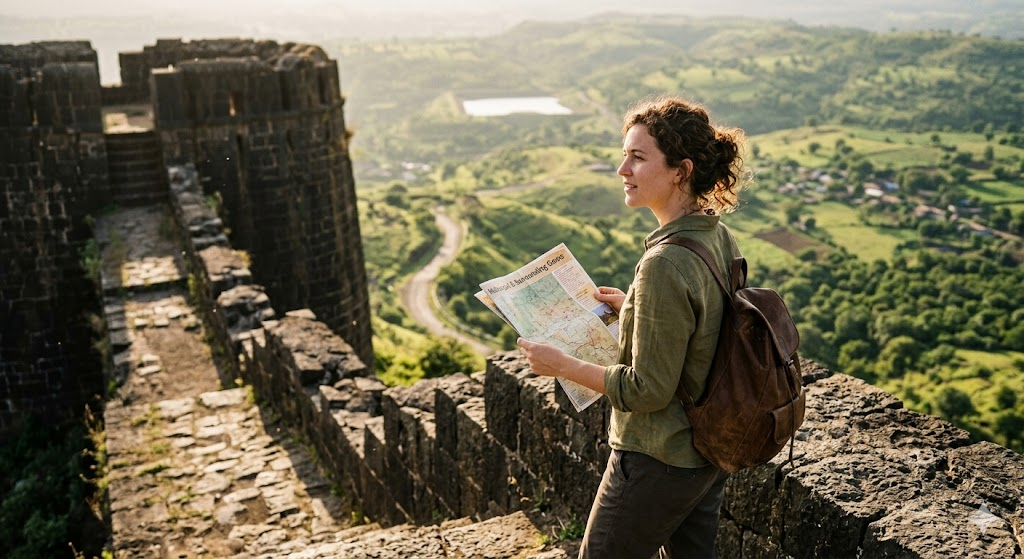
The Forgotten Stones of Mahurgad Fort
When I finally made the 20-minute trek up from the base village to Mahurgad Fort, I felt like I had stepped through a portal. While the nearby temple hills buzzed with chants, vendors, and crowds, the fort was shrouded in a peaceful, quiet mystery. The path winds through dense teak forests where I actually spotted a few peacocks darting through the brush.
Originally built before the Yadav period and later controlled by everyone from the Gond kings to the Bahmani Sultanate, and eventually the Mughal Empire, this place is a massive testament to centuries of regional power struggles.
Here are the standout spots within the fort that you simply cannot skip:
- Hathi Darwaza (Elephant Gate): The sheer scale of this northern entrance is staggering. It was deliberately designed to allow an elephant with a seated rider to pass through effortlessly. Take a moment to notice the faded Persian blue tiles and the obscure carvings that still cling to the limestone archways.
- Mahakali Bastion: I highly recommend pushing through the fatigue and climbing up to this point. It is the highest structure in the fort, sitting at roughly 2,650 feet above sea level. The panoramic view of the Painganga valley from here is absolutely breathtaking. Inside the bastion, you can spot an ancient, ruined Deepmal and heavy stone cannonballs left behind from a forgotten siege.
- Chini Mahal and Hawa Mahal: Though largely in ruins today, the skeletal arches and central water cisterns give you a fascinating glimpse into the luxurious, strategic lives the Mughal Subedars once lived up here.
Pro Tip: Start your fort trek early in the morning, around 6:30 AM. The midday sun bouncing off the dark basalt rock can be brutal, and the early morning light makes for fantastic, moody photography without the harsh shadows.
Hidden Gems You Need to See
Once you have conquered the fort and taken in the history, the surrounding landscape across Nanded and Yavatmal holds several natural and historical wonders that are well worth the extra mileage.
1. Pandav Leni Caves
Just a stone’s throw from the fort (barely a kilometer away) lie the Mahur Caves, often referred to locally as Pandav Leni. These rock-cut Buddhist caves date back to between the 1st and 5th centuries. As I walked through the cool, dimly lit meditation halls, I was struck by the intricate carvings depicting scenes from the Buddha’s life and journey to enlightenment. It is a stark, serene contrast to the bustling Hindu temples just a few hills over, offering a quiet space for reflection and a deep dive into ancient Indian artistry.
2. Sahastrakund Waterfall
If you are visiting right after the monsoons, this is a non-negotiable stop. Located about 80 kilometers from Mahur on the Penganga River, the Sahastrakund Waterfall is a roaring, raw force of nature. The river violently cuts through unique, jagged black rock formations, creating multiple powerful cascades. I spent a good two hours here just listening to the water and taking in the misty breeze.
3. Unkeshwar Hot Springs
After a long day of trekking the fort’s uneven steps, my legs were begging for a break. I drove about 50 kilometers out to the Unkeshwar Hot Springs. These natural, sulfur-rich springs are famous locally for their mineral-dense, healing waters. Soaking in the warm pools while surrounded by rural, agricultural tranquility was the absolute perfect way to reset my muscles for the drive home.
Planning Your Trip: Expectation vs. Reality
Traveling in this specific pocket of Maharashtra requires a bit of flexibility. Here is a quick breakdown of what you might expect versus the reality I experienced on the ground.
| Aspect | What You Might Expect | The Reality I Found |
| Getting Around | Easy access to all major sites via local public transport. | You absolutely need a private vehicle or a hired taxi to comfortably hit the surrounding waterfalls and hot springs. |
| Crowds | Quiet everywhere since it is a rural district. | The main temples are packed shoulder-to-shoulder, but the fort and Buddhist caves are surprisingly empty. |
| Food Options | Plenty of cafes and tourist restaurants near the sites. | Stick to basic local dhabas for authentic Maharashtrian thalis; you must carry your own snacks for the fort. |
| Connectivity | High-speed mobile data everywhere in 2026. | The network is highly erratic on the fort’s peak and near the waterfalls. Download your maps offline beforehand. |
Final Thoughts
Mahur is a town with a fascinating dual identity. Yes, it is one of the most sacred pilgrimage sites in the state, but it is also a rugged, historically rich landscape waiting to be explored by those willing to walk a little further and climb a little higher. By venturing beyond the temple steps, I discovered a side of Maharashtra that felt beautifully untouched and profoundly authentic.
If you want to experience the complete spectrum of what the Mahurgad region has to offer, you need to plan strategically.
My Essential 2026 Mahurgad Checklist
- Rent a sturdy vehicle: The roads leading out to places like Sahastrakund can be rough in patches; an SUV with good ground clearance will make your life significantly easier.
- Pack proper footwear: Leave the sandals in the car. The basalt steps on the fort are steep and uneven, and the paths down to the caves can get slippery.
- Download offline maps: Cell service drops significantly once you leave the main town limits.
- Carry physical cash: Many small vendors near the fort base, parking attendants, and local eateries still prefer cash over digital payments due to network issues.
- Hydrate heavily: Bring at least two liters of water per person for the fort trek. There are no reliable drinking water sources once you pass the main entrance gates.
- Time it right: Aim for the post-monsoon window (September to November). The Sahyadri hills are covered in a vibrant, lush green, and the waterfalls are flowing at their absolute peak.